When a flight school hands you a list of insurance requirements, it feels straightforward. Get a policy that hits those numbers, bring in the certificate, and you're good to fly. Most renter pilots do exactly that. The problem is that meeting a school's minimum requirements and actually having coverage that protects you are two different things. Understanding that gap is worth your time before you ever sit in the left seat.
Why flight schools set minimums in the first place
Flight schools require renters insurance to protect themselves, not you. The minimums they list -- typically $1,000,000 in liability and somewhere between $10,000 and $100,000 in aircraft damage coverage -- are designed to ensure their assets and operations are covered if something goes wrong while you're flying their plane. That's a reasonable position for them to take. It just doesn't mean those numbers are the right fit for your specific situation as a pilot.
A school with a low deductible on their hull policy might require you to carry $5,000 in non-owned aircraft damage coverage. A school with no hull coverage at all might require $100,000. Neither of those numbers was calculated with your personal liability exposure in mind. They were calculated with the school's financial interests in mind.
What non-owned insurance actually covers
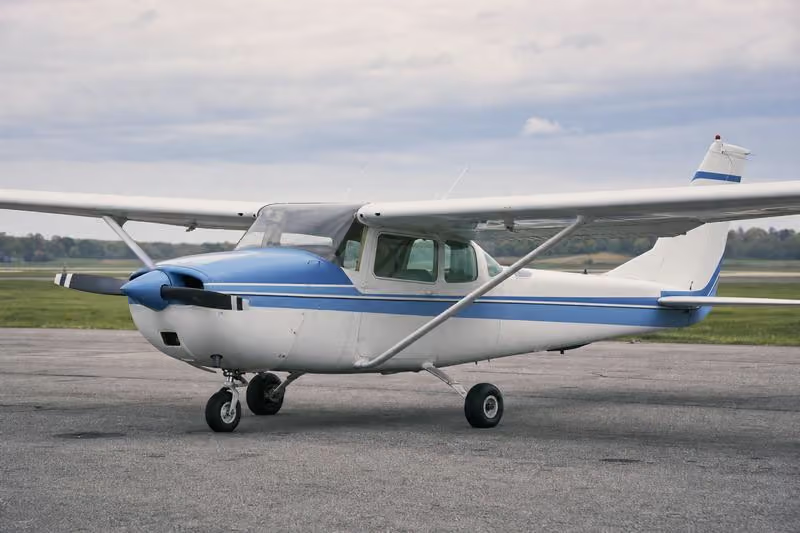
A non-owned aircraft insurance policy generally breaks into two main parts: liability coverage and aircraft physical damage coverage. Liability covers bodily injury and property damage you cause to third parties while flying. Aircraft physical damage covers your legal obligation to the aircraft owner for damage to the plane while you're flying it -- think the school's deductible, or full hull value if the owner has no insurance.
Here's where it gets important. The liability limit you carry follows you everywhere you fly non-owned aircraft, not just at that one flight school. If you're at $1,000,000 in liability and you cause a collision that injures multiple people or damages a $500,000 aircraft on the ramp, that limit can be exhausted fast. Many pilots carry higher limits than what their school requires specifically because they understand their own exposure, not because anyone told them to.
On the aircraft damage side, the school's required minimum might be $10,000. But if you're flying a Cirrus worth $750,000 and the school has a $25,000 deductible on their policy, your $10,000 in non-owned coverage leaves you personally exposed to the other $15,000. You met the requirement. You're still short.
The checkout coverage question
One scenario that catches renter pilots off guard: training flights and aircraft checkouts. Some non-owned policies limit or exclude coverage during dual instruction. If you're doing a checkout flight with a CFI in the right seat and something happens, your policy may not respond the way you expect. It's worth reading the exclusions section before you assume you're covered on every flight you take in a non-owned aircraft.
SkyWatch's aircraft renters insurance covers dual instruction flights, so checkouts and training hours are included. That's not universal across policies, so always confirm.
Daily, monthly, and annual coverage options
One practical point that helps renter pilots a lot: you don't have to buy an annual policy if you're not flying frequently. SkyWatch offers non-owned coverage on a daily, weekly, monthly, or annual basis. If you rent two or three times a month, an annual policy usually makes sense. If you're a student working toward your private and flying sporadically, a monthly or per-flight option keeps costs reasonable while still giving you real coverage when you need it.
The key is matching your coverage to how you actually fly, not just to what's on the flight school's checklist.
What to actually look at when comparing policies
Beyond the coverage numbers, a few things matter when you're choosing a non-owned policy:
- Does it cover you at multiple flight schools or locations, or is it tied to one specific aircraft?
- Are training flights and checkouts included?
- What's the aircraft damage limit, and how does it compare to the actual deductible on the planes you fly?
- Does the policy cover loss-of-use claims from the aircraft owner?
- Can you adjust your coverage limits mid-term if your flying changes?
Meeting the school's minimum gets you in the door. Understanding your own exposure determines whether you're actually protected.
Frequently asked questions
Does my flight school's insurance cover me as a renter pilot?
The flight school's hull and liability policy covers the school's interests, not yours personally. If you damage the aircraft or cause injury to a third party, the school's insurer may pursue you directly through subrogation. Your own non-owned aircraft insurance policy is what protects you in that scenario.
What is the difference between liability coverage and aircraft damage coverage in a non-owned policy?
Liability coverage pays for bodily injury and property damage you cause to third parties -- people on the ground, passengers in other aircraft, and so on. Aircraft damage coverage pays for physical damage to the aircraft you were flying, up to the limit in your policy. Both are separate coverages with separate limits.
Do I need non-owned insurance if I only fly occasionally?
Yes. A single incident can result in a claim far larger than what most pilots expect. Flying once a month doesn't reduce your exposure during the flights you do take. If you fly infrequently, a daily or monthly policy keeps the cost low while still covering you on every flight.
Does non-owned aircraft insurance cover flights with a flight instructor on board?
It depends on the policy. Some policies exclude or limit coverage during dual instruction. Others, like SkyWatch's student pilot insurance and renter coverage, include dual instruction flights. Always check the exclusions section of any policy before assuming training flights are covered.
Can I get non-owned insurance that covers me at multiple flight schools?
Yes. Most non-owned aircraft insurance policies cover you wherever you fly non-owned aircraft, not just at one specific school. The coverage follows you as the pilot. If you fly at multiple locations or rent from different operators, confirm with your insurer that your policy doesn't restrict you to a single location.